

CF-200 Algae Bloom Monitor
Continuous chlorophyll-A fluorescence monitoring for fresh water and seawater intakes, helping operators identify rising algae concentrations early.
Continuous algae-bloom indication
The CF-200 integrates a C-Fluor probe, bypass assembly, controller and outputs for continuous chlorophyll-A measurement.
01 / MEASUREMENT
Direct chlorophyll-A measurement
The LED-based probe tracks chlorophyll-A without chemicals, reagents or moving analytical parts.
- Seawater measurement range
- Freshwater measurement range
- Long-life LED probe
02 / OPERATION
Early operational warning
Local display, alarm relays and 4-20 mA output help operators respond before algae loading disrupts treatment.
- Two alarm relays
- 4-20 mA output
- Continuous readings
Core CF-200 information
Separate ranges are published for seawater and freshwater using the supplied bypass and isolation assembly.
Ready-to-install assembly
Probe, controller, bypass and backplate arrive integrated.
No analytical chemicals
Fluorescence needs no reagents or moving analytical parts.
Robust water measurement
The probe tolerates bubbles, silt and debris.
Local and remote indication
Use display, relays and 4-20 mA together.
A continuous chlorophyll-A measurement path
A sidestream passes the probe so the system can track algae-related pigment and alert operators.
01.
Deliver the water
Route representative fresh water or seawater through the bypass.
02.
Excite chlorophyll-A
The LED probe applies optical excitation.
03.
Measure emission
The probe detects chlorophyll-A fluorescence.
04.
Display the result
The controller presents the current measurement.
05.
Transmit the signal
A 4-20 mA output sends the result to plant control.
06.
Trigger an alert
Two relays warn when thresholds are reached.
Early algae indication for water-intake protection
Use CF-200 to trend chlorophyll-A as an indicator of algae or plankton loading in fresh water and seawater.
Features
- Continuous chlorophyll-A measurement
- C-Fluor fluorescence probe
- No chemicals or reagents
- No moving analytical parts
- Long-life LED probe
- Integrated bypass assembly
- Isolation for probe removal
- Dual-line local display
- Two configurable alarm relays
- 4-20 mA process output
- NEMA 4X controller front
- 316 stainless-steel backplate
Applications
- Seawater intake monitoring
- Fresh-water intake monitoring
- Reverse-osmosis pretreatment
- Desalination plants
- Algae-bloom warning
- Plankton trend monitoring
- Membrane protection
- Reservoir monitoring
- Raw-water monitoring
- Cooling-water intake
- Industrial water intakes
- Aquaculture water checks
- Water-treatment optimisation
- Process-water monitoring
- Research installations
Targets and measurements
- Chlorophyll-A in seawater
- Chlorophyll-A in freshwater
- Algae concentration trends
- Plankton biomass indication
- Seawater bloom events
- Freshwater bloom events
- Intake-water changes
- Pretreatment loading
- Membrane-fouling risk
- Raw-water variation
- Seasonal algae growth
- Weather-driven changes
- Reservoir algae trends
- Cooling-intake algae
- Process-water algae
- 4-20 mA trend output
- Relay alarm thresholds
- Local display values
Chlorophyll-A indicates algal biomass. Confirm sampling, thresholds and any laboratory identification or toxin testing separately.
Designed as an integrated monitoring assembly
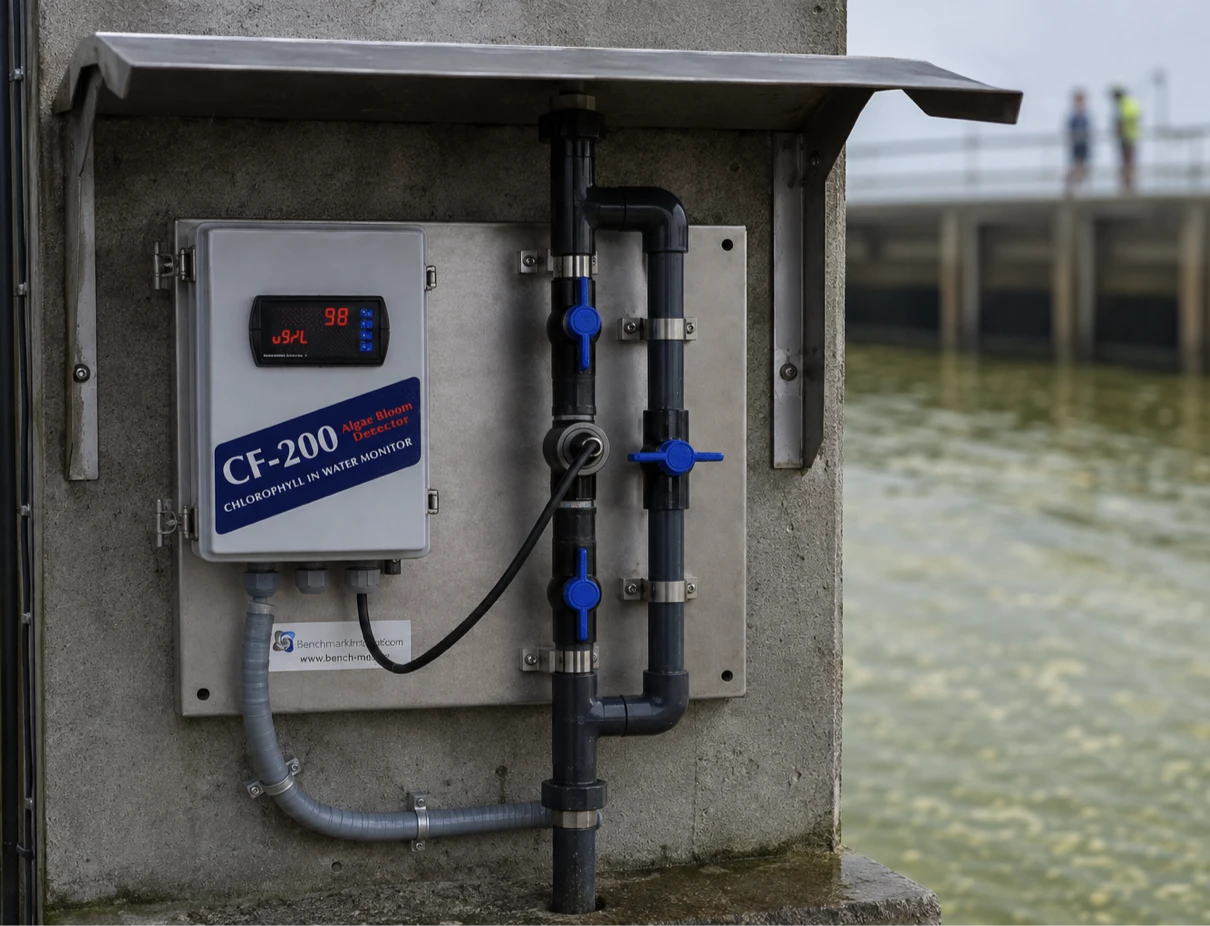
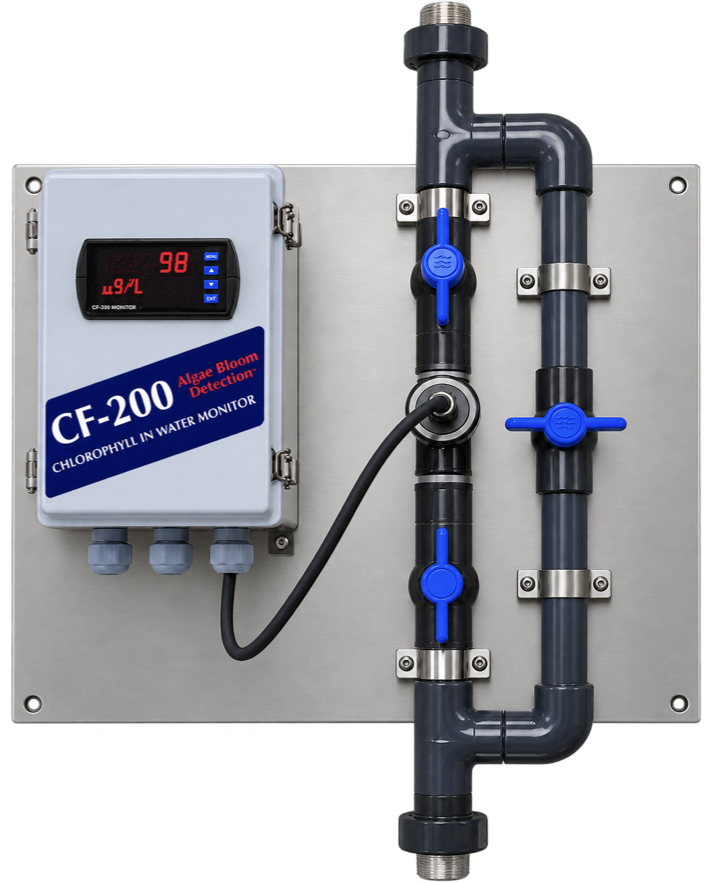
The CF-200 combines probe, bypass, isolation, display and transmitter on a prepared stainless-steel backplate.
C-Fluor probe
LED fluorescence provides chlorophyll-A measurement.
Bypass assembly
A one-inch PVC union and isolation support access.
Local controller
The dual-line display provides measurement and status.
Plant integration
Two relays and 4-20 mA provide alarm and trending.
Built for long-term algae-bloom awareness
01
Continuous measurement
Track chlorophyll-A between manual samples.
02
Freshwater range
Measure 0 to 500 μg/L in fresh water.
03
Seawater range
Measure 0 to 100 μg/L in seawater.
04
Long-life probe
Published LED life is greater than five years.
05
No reagents
Measurement consumes no analytical chemicals.
06
No moving parts
The probe has no moving analytical components.
07
Industrial outputs
Use two relays and 4-20 mA for alerts.
08
Robust installation
Titanium and CPVC form the wetted parts.
09
Wide ambient range
Controller operation is -40 to 65°C.
Technical specifications
Published CF-200 information for application and installation review.
| Measurement principle | Chlorophyll-A fluorescence |
| Seawater range | 0-100 μg/L chlorophyll-A |
| Freshwater range | 0-500 μg/L chlorophyll-A |
| Process connection | 1-inch PVC union, threaded or socket |
| Wetted parts | Titanium and CPVC |
| Maximum pressure | 3 bar (45 psi) |
| Outputs | 4-20 mA and two 3 A Form C relays |
| Power | 85-275 VAC; 20 W maximum |
| Controller rating | NEMA 4X, IP65; -40 to 65°C |
Confirm water type, sampling arrangement and site alarm thresholds with PMA.
Where the CF-200 can be used
The system suits fresh-water or seawater applications where algae loading affects downstream treatment.
Desalination intake
Trend plankton before pretreatment and membranes.
Fresh-water abstraction
Identify seasonal chlorophyll-A increases.
Industrial cooling intake
Warn where algae can restrict screens or filters.
Chlorophyll-A does not identify every bloom hazard
Use species identification, toxin analysis and statutory monitoring where required.
How does chlorophyll-A fluorescence monitoring work?
The CF-200 excites chlorophyll-A and relates emitted fluorescence to concentration.
Why measure chlorophyll-A?
It is the primary algal pigment and indicates biomass.
Does it need reagents?
No. The C-Fluor probe uses LED fluorescence.
How is the probe maintained?
The bypass and isolation assembly permits removal and cleaning.