
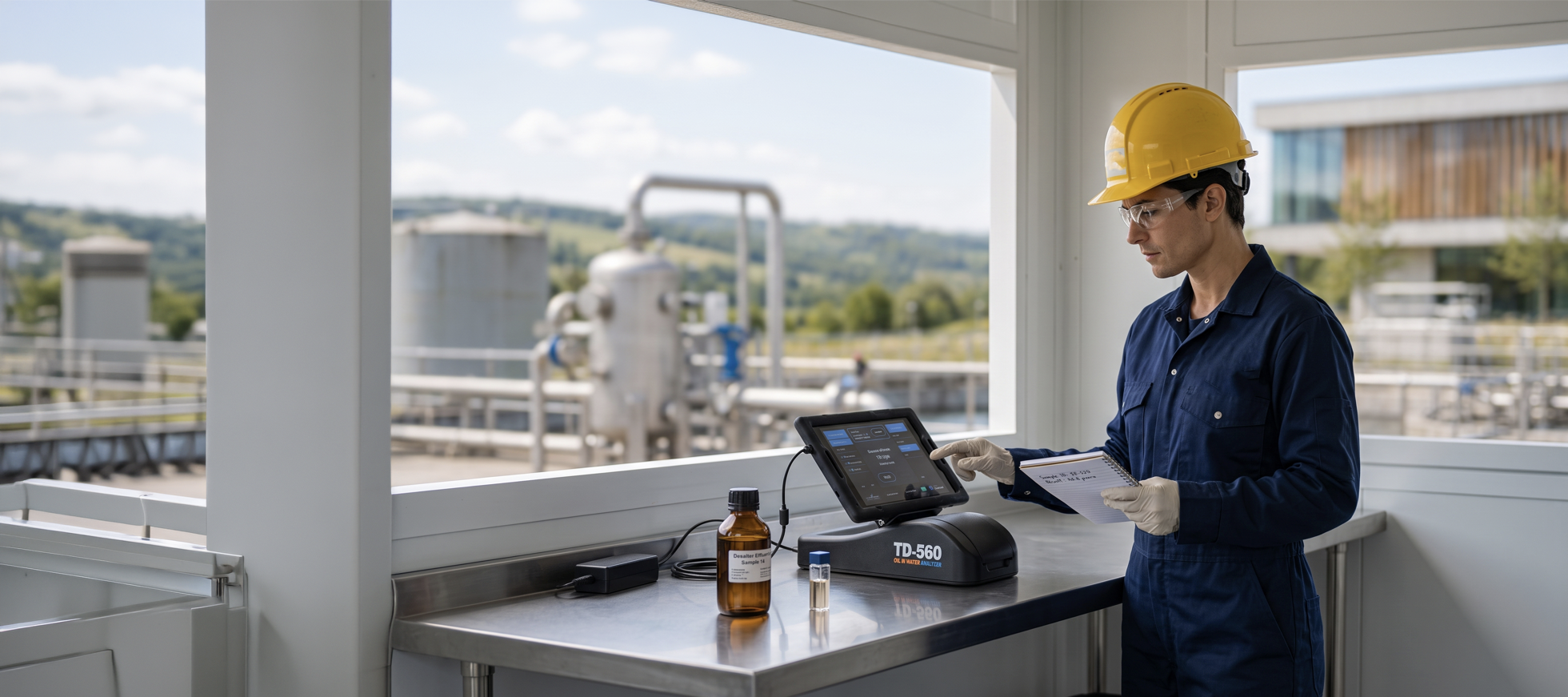
TD-560 Portable Oil-in-Water Analyser
Dual-channel portable UV fluorescence analysis for crude oils and lighter hydrocarbons including BTEX, gasoline, condensates and refined fuels.
Portable analysis across heavy and light hydrocarbons
The TD-560 adds a second optical channel to the TD-550 platform, extending grab-sample analysis to lighter and refined hydrocarbon targets.
01 / MEASUREMENT
Two optical channels
Analyse crude oil and heavier targets, then select the additional channel for BTEX, fuels, condensates and lighter products.
- Low ppb detection capability
- Up to 5000 ppm range
- Target-specific calibration
02 / OPERATION
Broader hydrocarbon selection
Choose channel, cuvette, calibration and extraction ratio to match the hydrocarbon and reporting objective.
- Dual-channel selection
- Saved target calibrations
- Flexible extraction methods
Core TD-560 information
The second optical channel expands target coverage while retaining the portable touchscreen, battery and data platform.
Broader target coverage
Measure TD-550 targets plus lighter fuels, aromatics and condensates.
Stored calibrations
Retain multiple calibrations, locations and extraction settings.
Flexible display units
View results in ppm, ppb, mg/L, μg/L or raw units.
Method correlation
Correlate results with USEPA 1664A and ISO 9377-1.
A flexible dual-channel workflow
Select the channel, calibration, cuvette and extraction ratio that match the target hydrocarbon.
01.
Identify the target
Confirm whether the sample contains heavier oil or lighter hydrocarbons.
02.
Select the channel
Choose the appropriate optical channel and saved calibration.
03.
Prepare the sample
Apply the agreed extraction or approved no-solvent procedure.
04.
Load the cuvette
Use the configured cuvette and extraction ratio.
05.
Analyse the result
Review concentration, raw signal and graphing.
06.
Store and export
Save the result with its location and transfer the record.
One portable platform for broader hydrocarbon coverage
Choose TD-560 when lighter aromatics, refined fuels or gas condensates may be measured alongside heavier oils.
Features
- Dual optical channels
- Full-colour touchscreen
- Advanced data logging
- Saved calibrations and sites
- USB data output
- MicroSD data storage
- Direct and raw calibration
- Multiple display units
- Portable battery operation
- External mains power
- Flexible extraction methods
- CE-approved platform
Applications
- Produced-water checks
- Industrial wastewater
- Steam condensate
- Cooling-water monitoring
- Intake protection
- Discharge compliance
- Oil-in-soil analysis
- Stormwater monitoring
- Treatment verification
- Refinery wastewater
- Petrochemical facilities
- Marine and offshore work
- Environmental investigations
- Site-to-site surveys
- Laboratory correlation
Targets and measurements
- Crude oil
- Diesel
- Lubrication oils
- Fuel oils
- Gas condensates
- BTEX
- Gasoline
- Styrene
- Phenol
- Jet fuel
- Kerosene
- Heat-transfer fluids
- Hydraulic oils
- Transformer oils
- Produced-water hydrocarbons
- Refinery wastewater
- Petrochemical wastewater
- Raw fluorescence signal
The 5 ppb to 5000 ppm range is target dependent. Confirm channel, calibration, preparation and background before specification.
Designed for broader portable analysis
The TD-560 retains the TD-550 workflow while adding a second channel for lighter hydrocarbons.
Channel selection
Choose the optical channel matching the target hydrocarbon.
Data history
Filter records by calibration, date or sampling location.
Portable power
Use the internal battery or connect external power.
Flexible methods
Configure cuvette, ratio, calibration and result units.

Built for complex hydrocarbon investigations
01
Dual-channel detection
Extend analysis from crude oil to lighter aromatic targets.
02
Wide measuring range
The published range extends from low ppb to 5000 ppm.
03
Target calibration
Store response curves for oils and chemicals at each site.
04
Full-colour interface
The touchscreen supports analysis and graph review.
05
Multiple locations
Store site names with calibrations and sample records.
06
Flexible extraction
Use popular solvents or the no-solvent method.
07
Battery operation
Six to eight hours supports mobile sampling work.
08
Data export
USB and MicroSD support reporting and traceability.
09
Method correlation
Correlate site methods to recognised laboratory procedures.
Technical specifications
Published TD-560 information for application and specification review.
| Measurement principle | Dual-channel UV fluorescence |
| Common targets | TD-550 oils plus BTEX, fuels, condensates and lighter hydrocarbons |
| Detection range | 5 ppb to 5000 ppm, target dependent |
| Power | 90-240 VAC external supply; 6-8 hours battery |
| Data output | USB and MicroSD card |
| Calibration | Direct and raw |
| Display units | ppm, ppb, mg/L, μg/L and raw |
| Approvals | CE |
| Data management | Multiple calibrations, sites, timestamps and graphing |
Confirm target, optical channel, calibration and preparation with PMA.

Where the TD-560 can be used
Choose TD-560 where work may involve heavier oils and lighter refined or aromatic hydrocarbons.
Refineries and petrochemicals
Investigate fuels, BTEX, phenol, condensates and wastewater.
Produced and process water
Verify treatment where hydrocarbon composition can change.
Environmental response
Screen spills and discharges containing mixed petroleum products.
Portable screening does not replace required laboratory analysis
Use accredited methods and statutory sampling where the permit or investigation requires them.
How does dual-channel fluorescence analysis work?
The TD-560 provides two optical channels so the method can match heavier oils or lighter hydrocarbon targets.
When is TD-560 preferred?
Choose it for BTEX, gasoline, condensates, jet fuel or lighter targets.
Can both channels use saved calibrations?
Store multiple calibrations and select the channel for each sample.
What controls the usable range?
Composition, background, extraction, cuvette and calibration all matter.
Continue your oil-in-water research
Move directly to the guide, comparison or application route that matches your next decision.
Oil-in-Water Monitor Guide
Compare continuous monitoring with portable analysis and plan the complete measurement.
Portable Analyser Range
Compare the TD-550 and TD-560 around the target hydrocarbon and application.
TD-550 vs TD-560
Choose the portable platform that best matches crude oil, fuels or lighter hydrocarbons.
Discuss Your Sample
Share the hydrocarbon target, expected range, water matrix and sampling method.