

TD-120 Online Oil-in-Water Monitor
Continuous UV fluorescence monitoring for oil in water, with fast response, local display, configurable alarms and 4-20 mA process integration.
Continuous monitoring for rapid oil detection
The TD-120 measures a flowing sample continuously, helping operators detect leaks, protect assets and optimise water-treatment processes. Review the wider oil-in-water monitor selection guide for sampling, calibration and alarm-planning principles.
01 / MEASUREMENT
Fast UV fluorescence response
A default three-second response can be adjusted down to 0.5 seconds for suitable applications and conditions.
- Low ppb sensitivity
- Up to 6000 ppm range
- Continuous readings
02 / OPERATION
Integrated process functions
Local controls, configurable alarms and optional automatic valves support practical installation and maintenance.
- Four alarm relays
- 4-20 mA output
- Optional HART communication
Core TD-120 information
Usable range depends on the target hydrocarbon, solubility, water background and application calibration.
Continuous sample flow
Recommended flow is 1 to 2 L/min within a 0.1 to 3 L/min limit.
Automatic valve options
Add temperature protection, fresh-water flush and isolation.
Local operation
Review history externally; configure through the internal tablet.
Site care packages
Select standard or tailored commissioning and calibration support.
A continuous online measurement path
A conditioned sidestream passes through the fluorescence cell for display, alarms and plant control.
01.
Deliver the sample
Provide a representative sidestream within pressure, temperature and flow limits.
02.
Excite the target
Ultraviolet light stimulates aromatic hydrocarbon fluorescence.
03.
Measure the signal
The detector measures fluorescence against stored calibration.
04.
Report concentration
Display ppm, ppb or raw signal continuously.
05.
Trigger alarms
Configured relays alert operators to changing conditions.
06.
Protect and flush
Optional valves isolate, protect and flush the cell.
Continuous oil-in-water monitoring for process protection
Use TD-120 where rapid detection, alarm output and plant integration matter more than portable grab-sample analysis.
Features
- Continuous UV fluorescence
- Low ppb detection capability
- Up to 6000 ppm range
- Three-second default response
- Adjustable 0.5-second response
- Local colour display
- Internal configuration tablet
- Four configurable alarm relays
- Isolated 4-20 mA output
- Optional HART communication
- Automatic valve options
- No reagents or instrument air
Applications
- Steam condensate
- Boiler-feed water
- Cooling water
- Heat-exchanger leak detection
- Membrane protection
- Desalination intake protection
- Dam sumps
- Produced-water treatment
- Process optimisation
- Refinery wastewater
- Petrochemical wastewater
- Discharge monitoring
- Oil-leak detection
- Fuel contamination alerts
- Remote process control
Targets and measurements
- Diesel
- Fuel oil
- Crude oil
- Gasoline
- Jet fuel
- Lubricating oils
- Phenol
- Heat-transfer fluids
- Aromatic chemicals
- Produced-water hydrocarbons
- Condensate contamination
- Cooling-water oil
- Boiler-feed oil
- Membrane-intake oil
- Process-water hydrocarbons
- Raw fluorescence signal
- PPM display
- PPB display
The low ppb to 6000 ppm range is application dependent. Confirm calibration, conditioning, pressure, temperature and flow.
Designed for dependable online operation
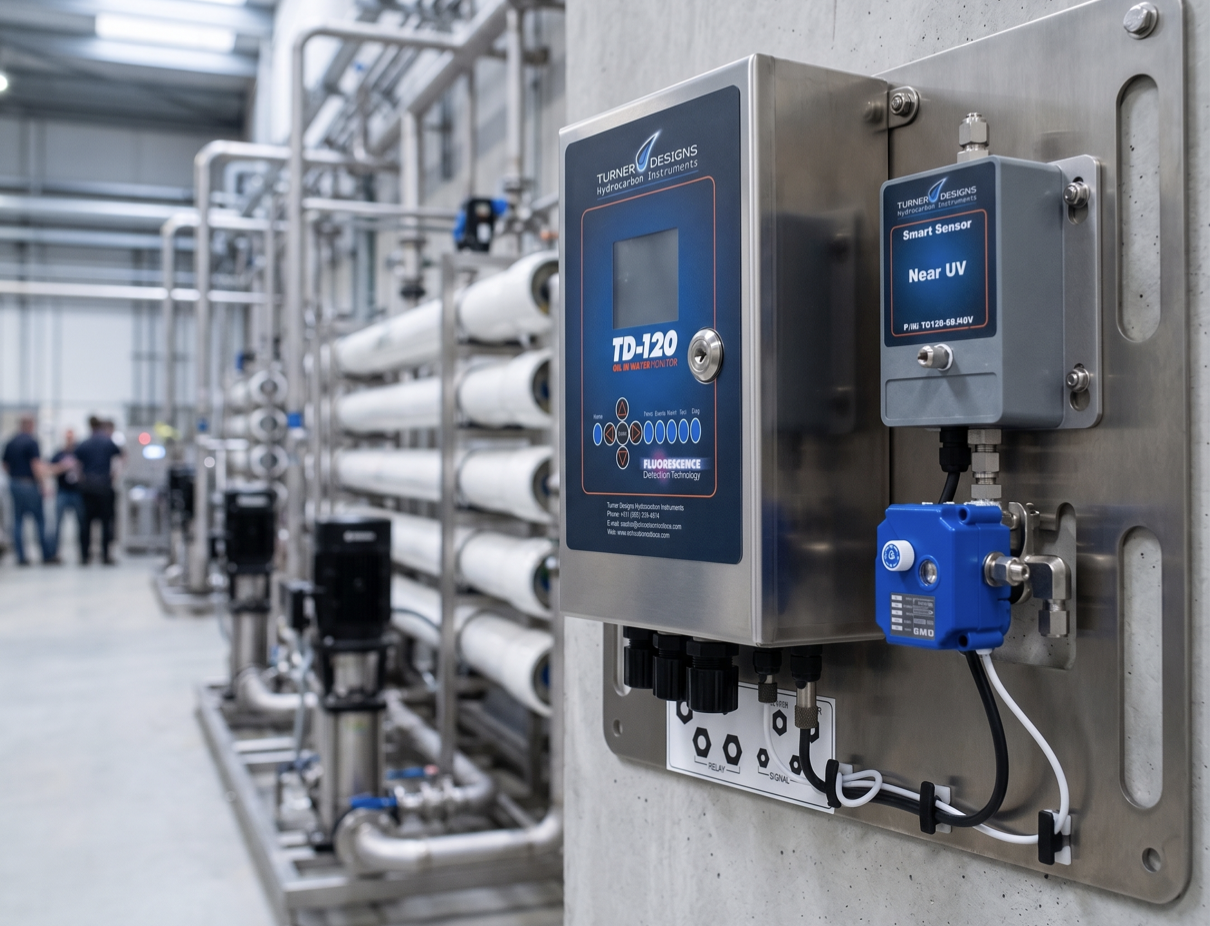
The TD-120 combines a stainless-steel flow cell, local controls and outputs in a compact wall-mounted package.
Local display
View concentration in ppm, ppb or raw signal.
Process outputs
Send 4-20 mA and relay alarms to plant control.
Sample protection
Optional valves support protection, isolation and flushing.
Low ownership cost
Operation needs no reagents or instrument air.
Built for rapid detection and process response
01
Continuous measurement
Track oil concentration without manual collection.
02
Fast response
Use three seconds by default or adjust to 0.5 seconds.
03
Extended range
Monitor from low ppb to 6000 ppm.
04
Four alarm functions
Configure process, system and cell-condition relays.
05
Analogue integration
Connect isolated 4-20 mA to plant monitoring.
06
Optional HART
Add digital communication where required.
07
Automatic valves
Protect, isolate and flush the sample path.
08
Stable calibration
Published stability is ±10 percent over 12 months or better.
09
Minimal consumables
No reagents or instrument air are required.
Technical specifications
Published TD-120 information for application and installation review.
| Measurement principle | Continuous UV fluorescence |
| Detection range | Low ppb to 6000 ppm, target dependent |
| Response time | 3 seconds default; adjustable down to 0.5 seconds |
| Recommended flow | 1-2 L/min within a 0.1-3 L/min limit |
| Sample temperature | 0-50°C |
| Ambient temperature | 0-55°C |
| Power | 100-240 VAC, 50/60 Hz |
| Outputs | Isolated 4-20 mA; optional HART; four alarm relays |
| Dimensions and weight | 406 x 508 x 140 mm; 10.9 kg |
Confirm target calibration and sample conditions with PMA before procurement.

Where the TD-120 can be used
The monitor suits continuous applications where a fast hydrocarbon alarm supports an operational decision.
Heat exchangers and boilers
Detect oil in cooling water, condensate or boiler feed.
Membranes and intakes
Protect reverse-osmosis and desalination assets.
Treatment optimisation
Track produced water through treatment and discharge.
Online monitoring supports compliance sampling
Retain required laboratory testing, statutory sampling and site procedures.
How does continuous UV fluorescence monitoring work?
The TD-120 detects aromatic hydrocarbon fluorescence and converts it through site calibration.
Why is response fast?
The flowing sample is measured optically without a reagent cycle.
What flow is required?
Permitted flow is 0.1 to 3 L/min; 1 to 2 L/min is recommended.
How is it calibrated?
Use known standards or target hydrocarbon and confirm against site samples.
Continue your oil-in-water research
Move directly to the guide, comparison or application route that matches your next decision.
Oil-in-Water Monitor Guide
Plan the monitor, sample delivery, calibration, alarms and operator response together.
Online Monitor Range
Review continuous oil-in-water monitoring requirements and where the TD-120 fits.
Cooling-Water Leak Detection
See how continuous monitoring can support earlier heat-exchanger leak investigation.
Discuss Your Installation
Share the target oil, expected range, sampling point, conditions and required outputs.