

Produced water and industrial wastewater can contain changing mixtures of crude oil, refined products, treatment chemicals, solids and background organic material. Effective oil in water monitoring therefore starts with the process decision, not simply a desired number on a display.
Portable UV fluorescence analysers can investigate several treatment stages. A continuous TD-120 oil in water monitor can provide rapid outlet trending, alarms and plant integration at a critical fixed point. Use our oil-in-water monitor specification guide to plan sampling, calibration and alarm strategy.
Define what the measurement must protect
The monitoring strategy may support treatment optimisation, discharge control, equipment protection, leak detection or incident investigation. Each purpose leads to different sample locations, alarm levels and verification requirements.
- Where can oil enter the water stream?
- Which treatment stage should respond to a rising result?
- Is the value used for operations, compliance screening or both?
- How quickly must the site react?
- What laboratory or reference method will support verification?
Portable testing across treatment stages
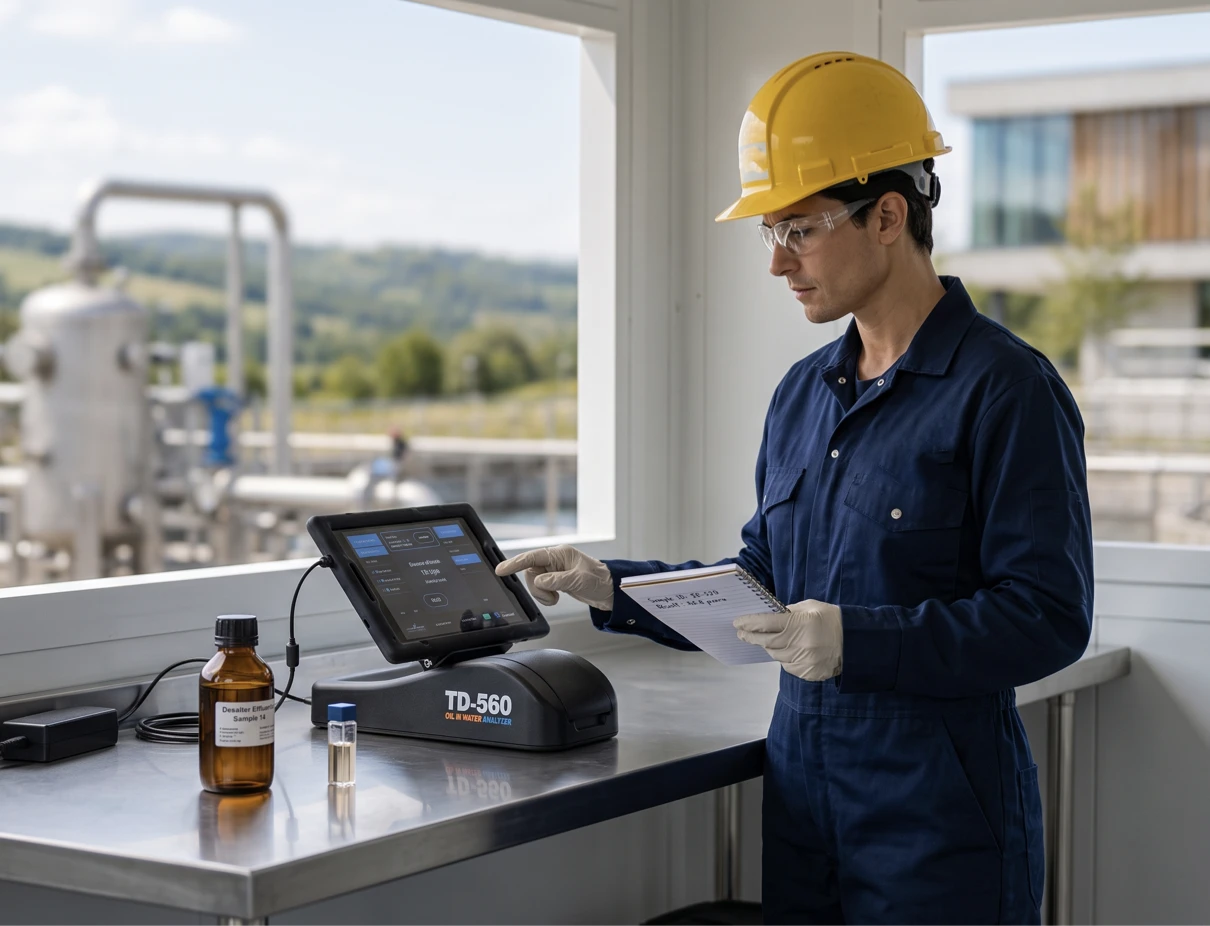
The TD-550 is suited to heavier oils such as crude oil, diesel and lubricating products. The TD-560 adds a second channel for lighter hydrocarbons such as BTEX, gasoline and condensates.
Portable testing allows an operator to compare inlet, intermediate and outlet samples, investigate separator performance and identify where a treatment change affects the hydrocarbon result.
Continuous outlet and process monitoring
A TD-120 can follow the process between manual sampling rounds. Its rapid response, alarm relays and 4-20 mA output allow the reading to become part of the site’s operational response rather than a result reviewed later.
Continuous data can reveal short events, gradual drift and repeated process patterns that an occasional grab sample may miss. Alarm levels should be based on the application, normal background and agreed action plan.
Choose a representative sample point
A sample point should capture the stream the site needs to understand. Dead legs, long residence times, phase separation and deposits can make the sample unrepresentative.
For an online monitor, the sidestream must also provide suitable flow, pressure and temperature. Sample return, flushing, isolation and maintenance access should be considered during the design rather than after installation.
Calibration for crude oil and mixed hydrocarbons
Fluorescence response depends on aromatic composition. A representative crude oil or process hydrocarbon is normally more useful than assuming every oil will respond in the same way.
Produced-water chemistry can change with wells, production conditions and treatment chemicals. Calibration and verification plans should account for those changes and define when the method needs to be reviewed.
Solids, droplets and sample handling
Oil can be dissolved, dispersed as droplets, attached to solids or separated as a surface layer. Sampling and transport can change that distribution before the measurement is made.
Consistent grab-sample handling supports portable analysis. For continuous monitoring, a well-designed sidestream and cleaning routine help maintain a stable relationship between the process and measurement cell.
Operational monitoring and compliance testing
Online and portable fluorescence results can provide valuable process information and early warning. They do not automatically replace statutory sampling or accredited laboratory analysis.
The site should document how operational readings, alarm responses, calibration checks and laboratory verification work together. That makes the monitoring system useful during normal operation and defensible during an investigation.
Frequently asked questions
Which analyser is best for produced water?
TD-550 is a strong portable starting point for crude oil and heavier petroleum products. TD-560 is appropriate where lighter hydrocarbons may also be important. TD-120 provides continuous monitoring at a fixed sample point.
Where should an online monitor be installed?
Choose a representative location linked to an operational decision, with suitable sample flow, pressure, temperature, return and maintenance access.
Can one calibration cover every crude oil?
Not reliably. Crude oils vary in aromatic composition and fluorescence response. Application-specific calibration or verification is normally required.
Can treatment chemicals interfere?
Some chemicals or matrix changes may alter background fluorescence or sampling behaviour. Review the complete water chemistry during application testing.
Should alarms match the discharge limit?
Not necessarily. An early operational alarm may be set below a final action threshold so the site has time to investigate and respond. Alarm strategy should be agreed for the process.
Plan a produced-water monitoring application
Contact PMA with the process description, target oil, expected range, water chemistry, sample conditions, proposed monitoring point and required outputs. We can help assess the portable, online or combined approach.
Explore the monitoring options
For product selection, application considerations and questions to discuss with PMA, explore produced-water oil monitoring and refinery wastewater oil monitoring.