

UV fluorescence is widely used for sensitive oil in water measurement because many petroleum products contain aromatic compounds that absorb ultraviolet energy and emit light at a longer wavelength. An analyser measures that emitted light and relates it to a calibration.
The method is used in PMA’s portable oil in water analysers and continuous monitors. Understanding what fluorescence measures, and what it does not measure, helps users select the correct instrument and calibration.
What happens during a UV fluorescence measurement?
A light source excites fluorescent components within the sample. Optical filters separate the excitation light from the emitted fluorescence, and a detector measures the resulting signal. The instrument then converts that signal into a reported concentration using the selected calibration.
This optical response can be highly sensitive, but it is not a universal mass measurement of every compound described as oil. The response depends on the aromatic composition of the target hydrocarbon.
Why aromatic composition matters
Crude oils, diesel, gasoline, lubricating oils and condensates do not fluoresce identically. Two products at the same gravimetric concentration can therefore produce different optical signals.
A representative target-oil calibration helps relate the instrument response to the material the site actually needs to detect. Where several products are possible, separate saved calibrations or a carefully agreed surrogate may be required.
Sensitivity and selectivity
UV fluorescence can detect low concentrations of suitable aromatic hydrocarbons and can be configured around particular excitation and emission wavelengths. This supports selective measurement in applications where a broad optical or turbidity response would be less useful.
Selectivity does not remove the need for application testing. Background fluorescence, other fluorescent chemicals and changes in the water matrix should be reviewed during method development and commissioning.
Portable fluorescence analysis
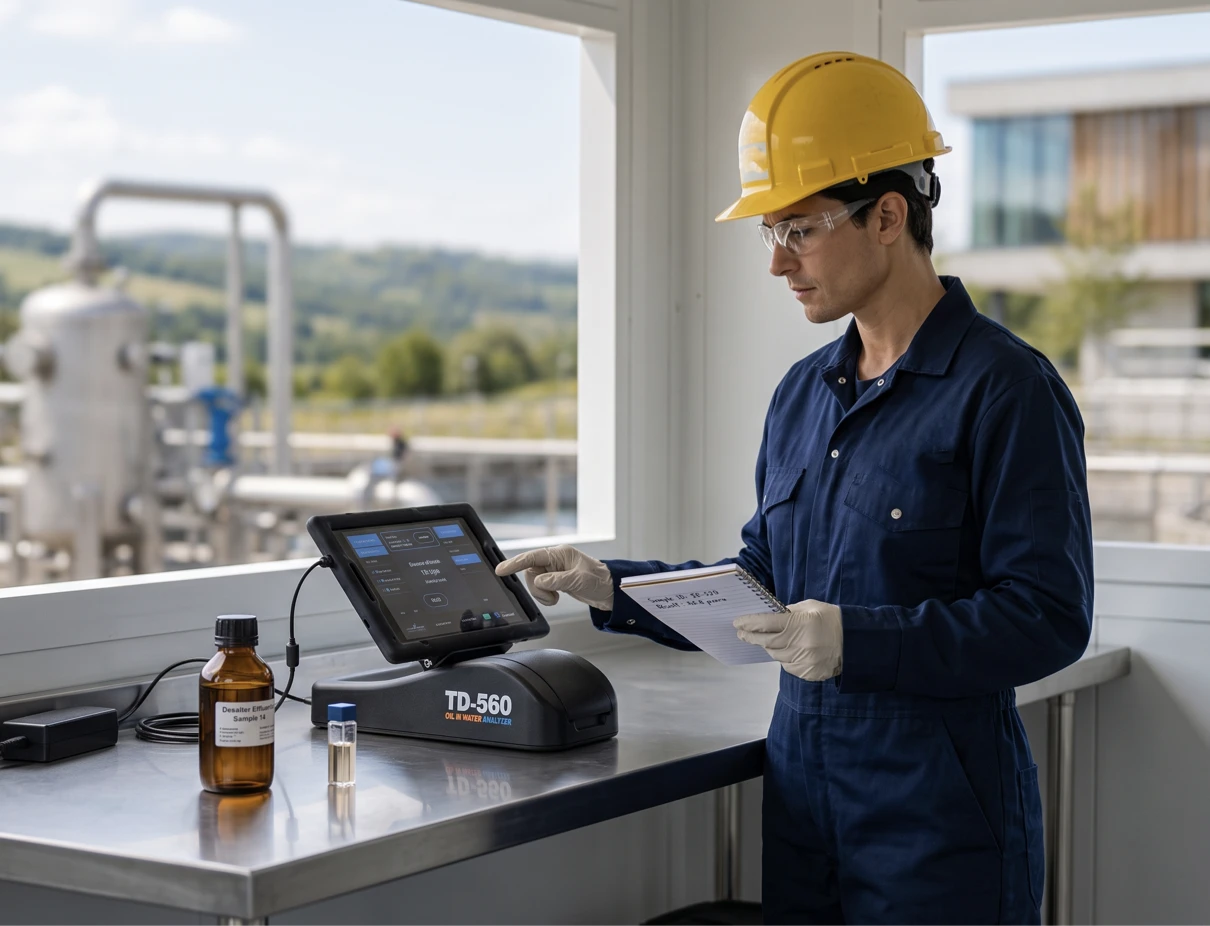
The TD-550 measures heavier petroleum products, while the dual-channel TD-560 extends measurement to lighter hydrocarbons and refined fuels.
Portable methods use a prepared grab sample. Depending on the agreed method, preparation may involve extraction or a documented no-solvent approach. Consistent sample volume, extraction ratio, cuvette condition and timing are important for repeatable results.
Continuous online fluorescence monitoring
The TD-120 measures a continuously supplied water sample. It provides rapid trending without requiring an operator to prepare every sample and can transmit alarms and an analogue signal to the plant.
An online system still depends on the sampling arrangement. Flow, pressure, temperature, representative sample transport and cell condition must be controlled so the optical measurement reflects the process.
Dissolved and dispersed hydrocarbons
Fluorescent hydrocarbons may be present in dissolved form or as droplets. Their distribution can change during sampling, transport and storage. Oil can float, settle with solids or adhere to pipework and containers.
Representative sampling and a suitable sidestream are therefore as important as the analyser. A strong instrument cannot correct a sample that never reaches it.
Common application areas
- Produced-water treatment and discharge trending
- Cooling-water and heat-exchanger leak detection
- Steam-condensate and boiler protection
- Refinery and petrochemical wastewater
- Raw-water intake and membrane protection
- Environmental investigation and stormwater screening
Frequently asked questions
Does UV fluorescence measure every type of oil?
No. Sensitivity depends on fluorescent aromatic components. The target product and calibration must be reviewed before specification.
Is turbidity completely irrelevant?
No. UV fluorescence can be more selective than general light-scattering methods, but high solids, fouling and matrix changes can still affect sampling and optical performance.
Can results be compared with a laboratory method?
They can be correlated through application-specific work using aligned sampling, extraction, standards and reference analysis. There is no universal conversion for every oil and matrix.
Why does TD-560 use two channels?
The second optical channel extends the range of hydrocarbon types that can be measured, particularly lighter refined products and BTEX-range compounds.
Review a UV fluorescence application
Ask PMA to review your application. Share the hydrocarbon, water matrix, expected range, sample conditions and the reference method or operational decision the measurement must support.
Explore the monitoring options
For product selection, application considerations and questions to discuss with PMA, explore continuous oil-in-water monitoring and cooling-water oil leak detection.