

Oil-in-water results are commonly reported in parts per million (ppm), milligrams per litre (mg/L) or micrograms per litre (µg/L). These units describe concentration, but the number is only meaningful when the measurement method and the hydrocarbon fraction being reported are also clear.
PPM and mg/L
For dilute aqueous samples with a density close to water, 1 ppm by mass is commonly treated as approximately 1 mg/L. This is a practical approximation, not a universal identity. Density, temperature and the precise definition of ppm can matter in tightly controlled work.
Converting between mg/L and µg/L
One milligram per litre equals 1,000 micrograms per litre. Therefore 0.1 mg/L equals 100 µg/L, while 30 mg/L equals 30,000 µg/L. Always retain enough significant figures for the method and avoid implying more precision than the analysis supports.
Why identical units can describe different measurements
A fluorescence result calibrated against a particular crude oil, a gravimetric oil-and-grease result and a chromatographic hydrocarbon index can all be expressed in mg/L. They may still represent different fractions of the sample. Units do not make unlike methods equivalent.
Instrument readings and oil-equivalent concentration
A UV fluorescence analyser detects fluorescent components and relates the response to a calibration. The reported value is therefore an oil-equivalent concentration for that calibration. Changing from crude oil to diesel, lubricant or condensate can change the response.
Good reporting practice
- State the unit and method together.
- Identify the calibration oil or surrogate.
- Record any extraction or dilution factor.
- Report the applicable detection and working range.
- Distinguish a screening or process trend from a regulatory reference result.
Selecting a suitable measuring range
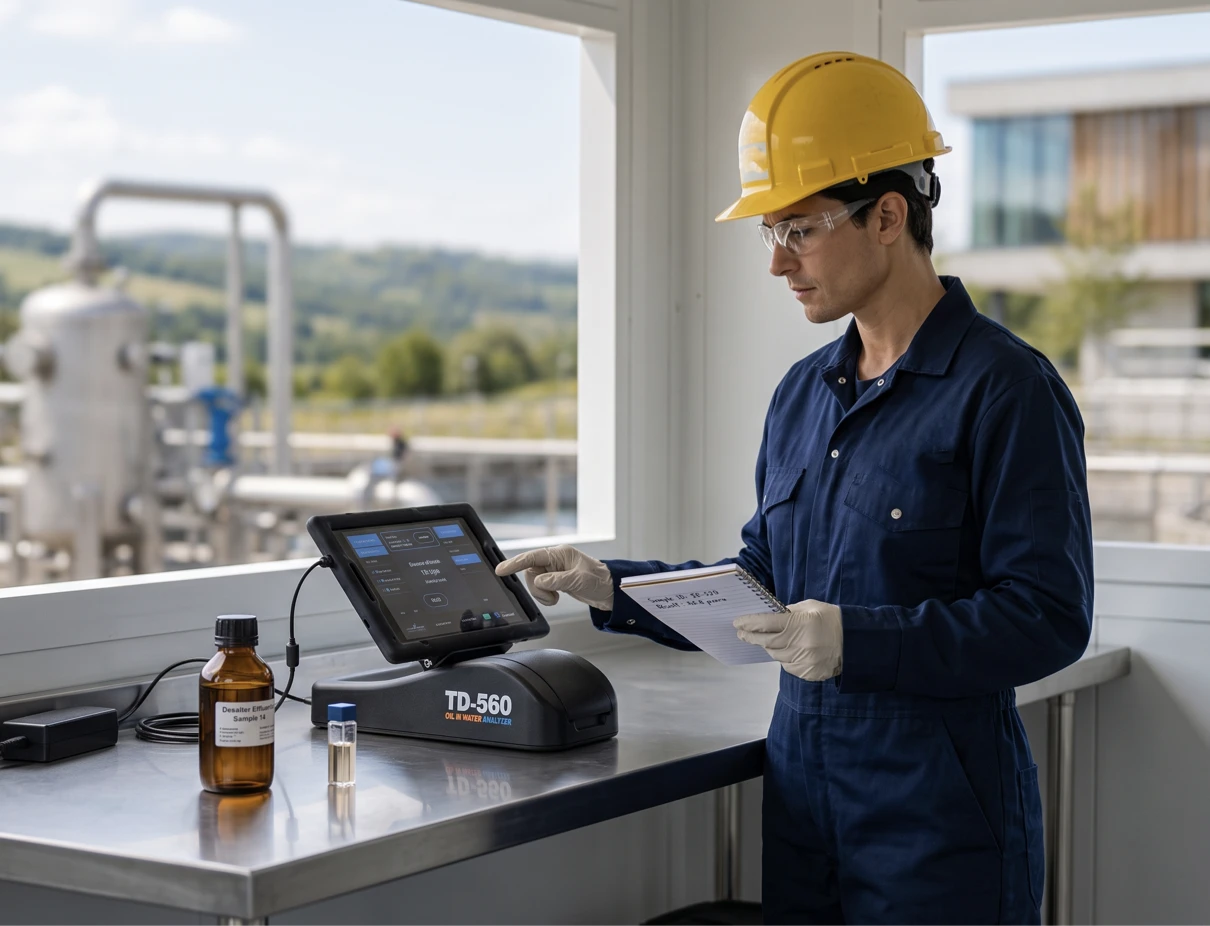
The useful range should cover the process baseline and the action level without placing routine readings at an extreme end of the calibration. For rapidly changing processes, a TD-120 online monitor can provide a continuous trend. For discrete samples, compare the TD-550 and TD-560.
Review your units and reporting objective
Contact PMA to discuss the expected concentration, target hydrocarbon and whether the result is required for screening, control, trending or comparison with a reference method.