

Continuous fluorescence monitoring can provide an immediate view of changing water conditions, but the correct monitor depends on what the site needs to detect.
TD-120 is an oil-in-water monitor for hydrocarbons. CF-200 is a chlorophyll-A monitor for algae-bloom indication. Both provide continuous readings and plant outputs, but they measure different targets and solve different operational problems.
Start with the measurement objective
A fixed online monitor should be selected around the decision operators need to make. Oil-leak detection, treatment optimisation and hydrocarbon ingress require a different optical configuration from algae or plankton trending.
TD-120 should be considered when the target is oil or an aromatic hydrocarbon. CF-200 should be considered when chlorophyll-A is being used as an indicator of algal biomass in fresh water or seawater.
The sample point, expected concentration, temperature, pressure, flow, background and required alarms should be reviewed before either monitor is specified.
What the TD-120 measures
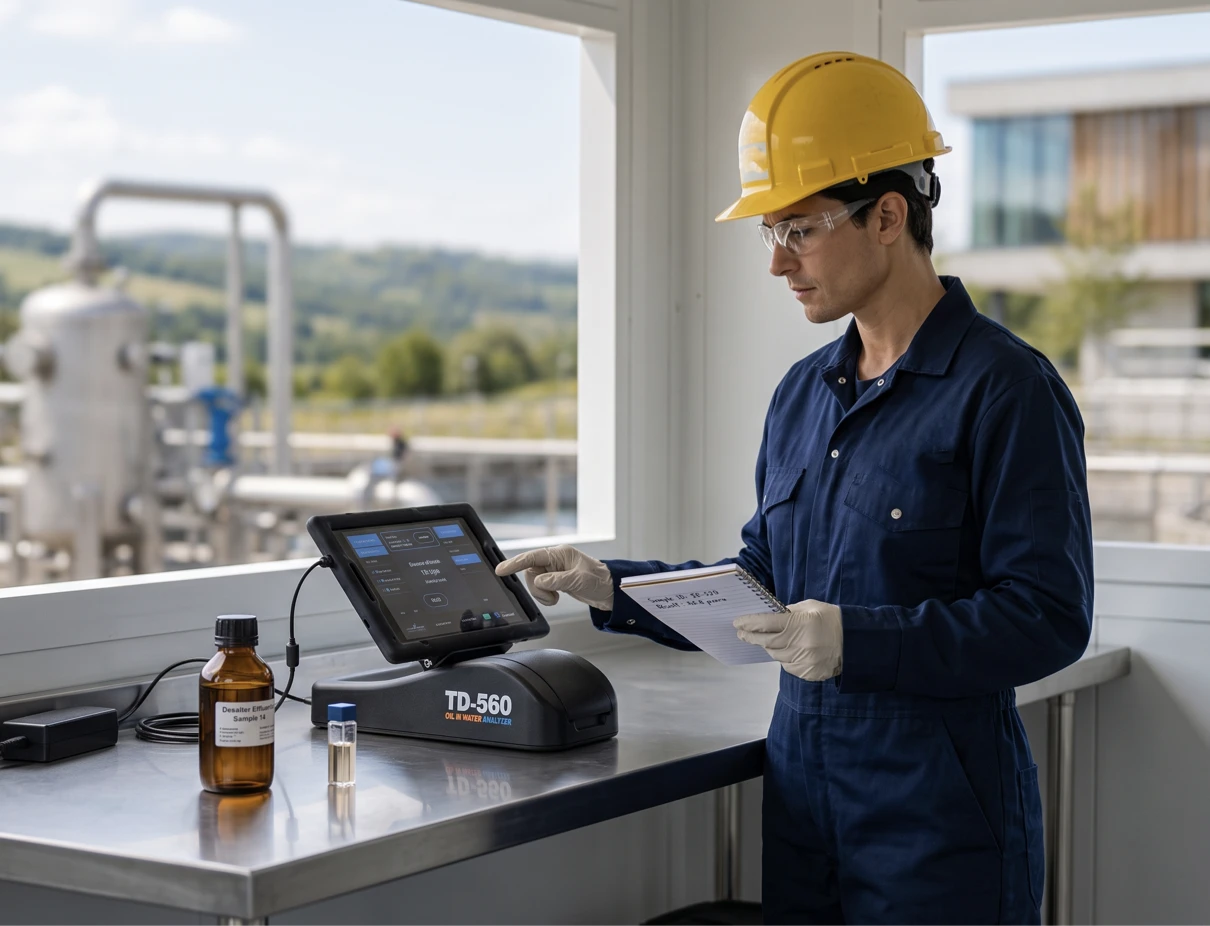
TD-120 uses UV fluorescence to detect aromatic hydrocarbon components in a continuously flowing water sample.
Published targets include diesel, fuel oil, crude oil, gasoline, jet fuel, lubricating oils, phenol, heat-transfer fluids and aromatic chemicals.
The application calibration and water background determine how the optical response relates to the concentration reported by the monitor.
TD-120 detection range and response
Published operating information lists a low-ppb to 6000 ppm range, dependent on the target oil, solubility and water background.
The default response time is three seconds and can be adjusted down to 0.5 seconds for suitable applications and operating conditions.
TD-120 sampling requirements
The monitor accepts a sidestream through quarter-inch feed, return and flush connections. Published sample inlet pressure is 10 to 100 psig.
The permitted flow range is 0.1 to 3 L/min, with 1 to 2 L/min recommended for normal operation.
Sample temperature is specified from 0 to 50°C, while the ambient operating range is 0 to 55°C.
TD-120 alarms and process outputs
Four dry-contact alarms can be assigned to early, high, system, cell-condition or high-temperature functions.
An isolated 4-20 mA output can be loop powered or instrument powered, and HART communication is available as an option.
These outputs allow the hydrocarbon reading and monitor condition to become part of the wider plant alarm and control strategy.
Automatic valve capabilities
Optional valve functions can provide high-temperature protection, fresh-water flushing and process isolation.
These functions help protect the measurement cell and support a planned maintenance routine, particularly where sample conditions can change.
They do not remove the need to inspect the sampling arrangement, confirm calibration and maintain the installed system.
What the CF-200 measures
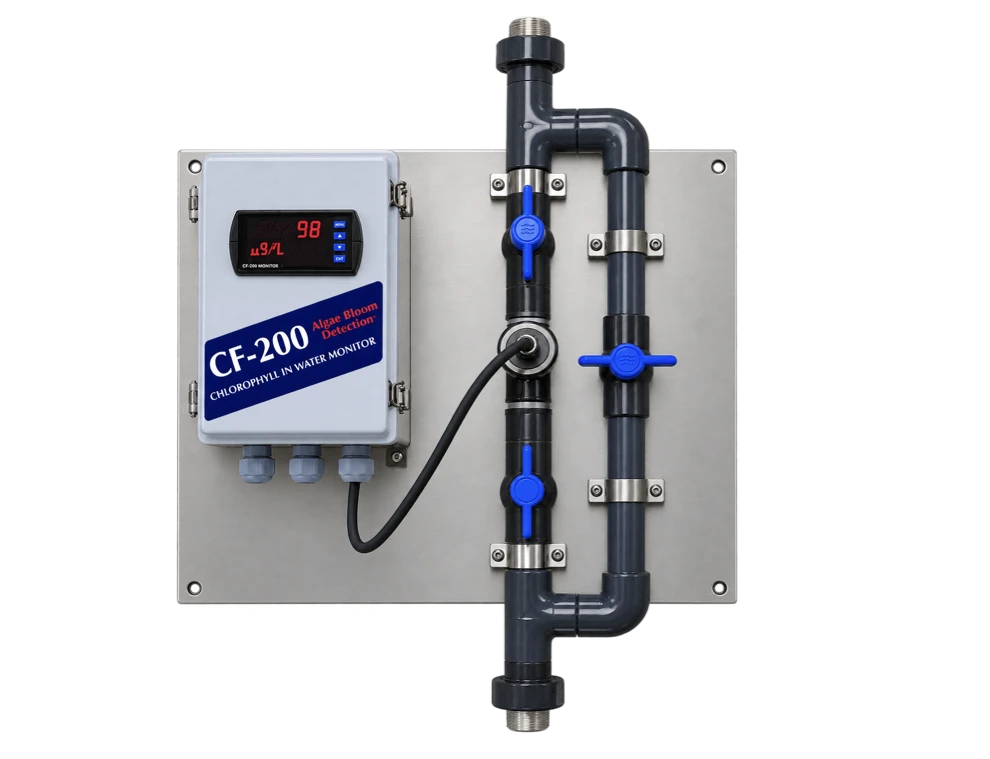
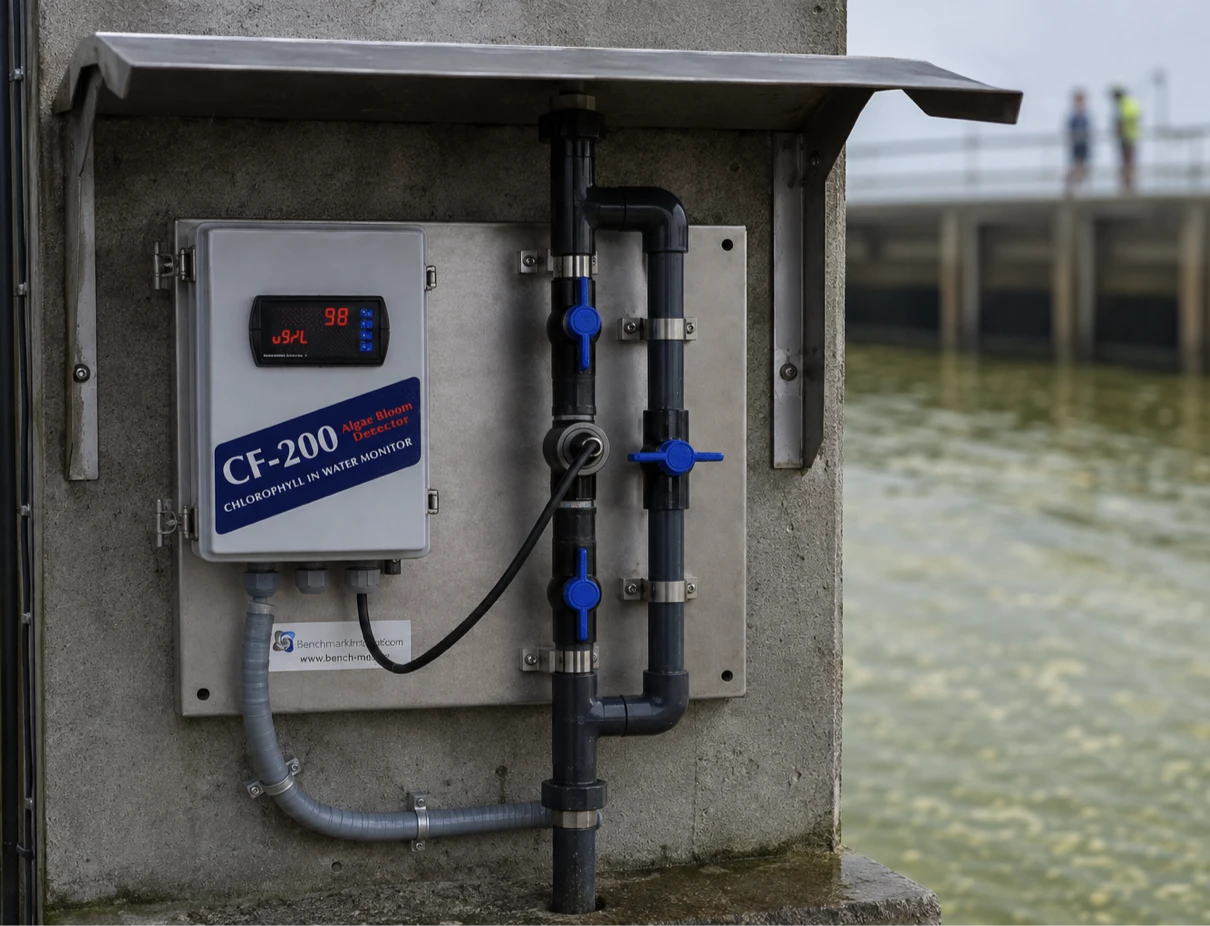
CF-200 uses a C-Fluor probe to measure chlorophyll-A continuously. Chlorophyll-A is the primary pigment in algae and provides an operational indicator of total algal or plankton biomass.
The published measurement range is 0 to 100 μg/L chlorophyll-A in seawater and 0 to 500 μg/L in fresh water.
The probe, bypass, isolation assembly, controller and transmitter are supplied as an integrated monitoring system.
Why chlorophyll-A monitoring matters
Algae loading can vary with season, weather and other changing intake conditions. High plankton concentrations can increase pressure loss and complicate membrane pretreatment.
A continuous trend can warn operators that conditions are changing before an occasional manual sample would otherwise be taken.
CF-200 outputs and installation
The controller provides a dual-line local display, two Form C alarm relays and a 4-20 mA output that can be loop or internally powered.
The front is rated NEMA 4X and IP65. Published power is 85 to 275 VAC with 20 W maximum consumption.
Process connection and materials
The bypass uses a one-inch PVC union with threaded or socket connection. Titanium and CPVC are the published wetted materials.
Maximum pressure is 3 bar or 45 psi, and the controller operating range is -40 to 65°C.
Maintenance and probe life
The LED-based probe uses no analytical chemicals, reagents or moving measurement parts. Its published probe life is greater than five years.
The bypass and isolation arrangement permits access for inspection or cleaning without turning the probe assembly into a difficult permanent installation.
Choosing TD-120 or CF-200
Choose TD-120 when the site needs continuous detection of oil, fuel or aromatic hydrocarbon contamination.
Choose CF-200 when the site needs continuous chlorophyll-A information for algae-bloom or plankton-loading awareness.
Frequently asked questions
Can TD-120 measure chlorophyll-A?
No. TD-120 is configured for hydrocarbon fluorescence, while CF-200 is designed for continuous chlorophyll-A monitoring.
Can CF-200 detect an oil leak?
No. CF-200 measures chlorophyll-A. Use TD-120 for a suitable continuous oil-in-water application.
How quickly does TD-120 respond?
The published default is three seconds, adjustable down to 0.5 seconds when the application permits.
Does CF-200 use analytical reagents?
No. The C-Fluor probe uses LED fluorescence without analytical chemicals or moving measurement parts.
Can both monitors connect to plant control?
Yes. Both provide 4-20 mA outputs, with product-specific alarm and communication options.
Which monitor suits desalination intake protection?
Use TD-120 for hydrocarbon ingress and CF-200 for chlorophyll-A or algae loading; some sites may need both measurements.
Do online monitors replace laboratory testing?
No. Retain laboratory, regulatory and site-specific verification appropriate to the application.
Discuss continuous monitoring with PMA
Share the target, expected range, water type, sample conditions and required outputs. PMA can help assess TD-120, CF-200 or a combined monitoring approach.
Explore the monitoring options
For product selection, application considerations and questions to discuss with PMA, explore online oil-in-water monitors and chlorophyll-A monitoring.