

Choosing between a portable oil in water analyser and a continuous online monitor starts with the decision the measurement must support. A portable instrument answers questions at selected sample points. An online monitor provides a continuous trend, alarm or plant signal from a fixed process location.
PMA supplies both approaches. The TD-550 and TD-560 are portable UV fluorescence analysers. The TD-120 is a continuous oil in water monitor. They use related optical principles but serve different operating needs.
Start with the measurement decision
Ask what happens after a result is produced. If an engineer needs to investigate several drains, treatment stages or process streams, portable analysis may be the practical choice. If operators need immediate warning of a leak or a continuous signal for process control, an online monitor is normally more suitable.
- How often is a result required?
- Will the measurement move between locations?
- Is a local reading enough, or must the value reach a control system?
- Does the site need an alarm between manual sampling rounds?
- Can a representative sidestream be provided continuously?
When a portable oil in water analyser is the better fit
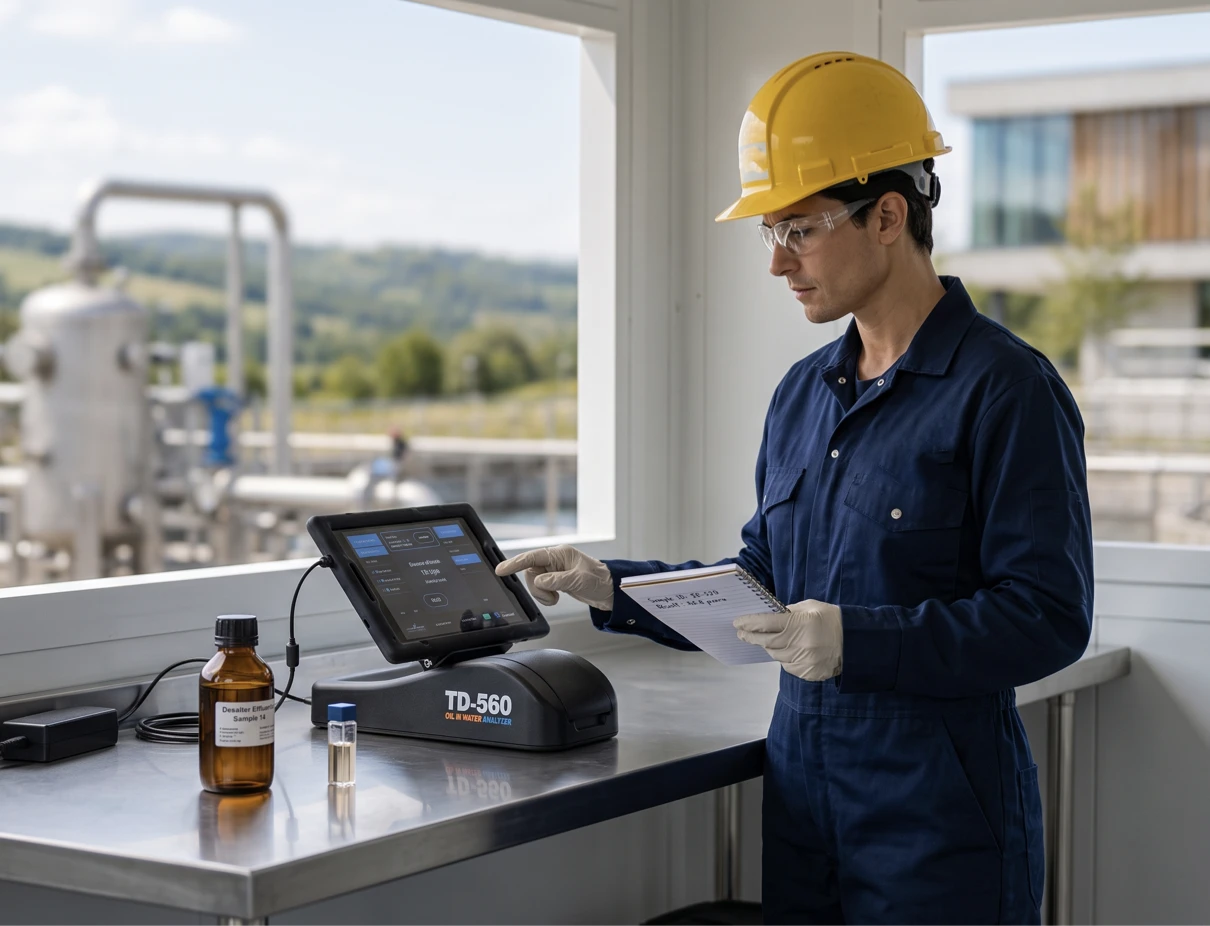
Portable analysers support grab-sample testing in the field or laboratory. They can be moved between sampling locations and used to compare upstream and downstream conditions without installing a separate monitor at every point.
The TD-550 is focused on crude oil, diesel, lubricating oils, fuel oils and other heavier petroleum products. The TD-560 adds a second optical channel for lighter hydrocarbons and refined products such as BTEX, gasoline, jet fuel and condensates.
Portable testing is especially useful for surveys, treatment checks, incident investigation, discharge screening and confirming where contamination enters a process. It also allows teams to store methods and use representative target-oil calibrations for different sites or products.
When continuous online monitoring is the better fit
Continuous monitoring is appropriate when the process can change between manual samples. The TD-120 measures a flowing sample and can provide rapid readings, alarms and a 4-20 mA signal for integration with plant systems.
Typical duties include cooling-water leak detection, steam-condensate protection, produced-water treatment, wastewater discharge trending and intake protection. The value is not simply more measurements. It is the ability to identify a change quickly enough for operators or control systems to respond.
Portable and online instruments can work together
Many sites benefit from both approaches. A TD-120 can provide the continuous trend at a critical outlet while a TD-550 or TD-560 is used to investigate individual sources, verify treatment stages or confirm conditions at other locations.
Portable results can also support commissioning and application work for an online monitor. The two methods should use an agreed calibration basis and representative samples so that operators understand how the readings relate.
Sampling and calibration still determine the result
Oil in water is not a single universal substance. Crude oil, diesel, condensate and hydraulic fluid can produce different fluorescence responses. The water background, solids, salinity, temperature and the physical form of the oil can also affect the practical measurement.
For that reason, model selection should start with the real target hydrocarbon and expected concentration range. PMA can then review the calibration, sample preparation, sidestream arrangement and reporting objective.
Frequently asked questions
Is a portable analyser less accurate than an online monitor?
Portable and online instruments are designed for different sampling modes. Performance depends on the application, calibration, sample handling and installation rather than portability alone.
Can a portable analyser provide continuous alarms?
No. The TD-550 and TD-560 analyse individual samples. Use the TD-120 where a continuous signal and alarms are required.
Can one online monitor cover several sample points?
A sampling system may be designed around more than one stream, but switching arrangements introduce delay and engineering considerations. Critical points are often monitored continuously and independently.
Which portable model should I choose?
Choose TD-550 for heavier oils. Choose TD-560 where lighter refined fuels, condensates or BTEX-range compounds may also need to be measured.
Do these instruments replace laboratory compliance analysis?
No. Retain accredited laboratory analysis and statutory sampling wherever a permit, contract or investigation requires it.
Discuss the monitoring approach with PMA
Contact PMA with the target oil, expected range, water type, sample locations, measurement frequency and required outputs. We can help identify whether portable analysis, continuous monitoring or a combined approach best fits the application.
Explore the monitoring options
For product selection, application considerations and questions to discuss with PMA, explore portable oil-in-water analysers and online oil-in-water monitors.