
Calibration establishes the relationship between an analyser response and a known reference. For UV fluorescence oil-in-water analysis, that relationship is application-specific because different crude oils, fuels and lubricants do not produce identical fluorescence at the same mass concentration.
A reliable calibration plan therefore begins with the material the site needs to measure. It should also define the blank, sample preparation, working range and checks used to confirm that the instrument remains stable.
Choose a representative calibration material
The closest practical match is usually the target oil or fuel from the process. If that is unavailable, a documented surrogate may be used, but its relationship to the target must be demonstrated rather than assumed. Sites exposed to several products may need separate saved calibrations.
Prepare the blank correctly
The blank should represent the method without the target hydrocarbon. For direct aqueous analysis this may be representative clean water. For an extraction method it may be the clean extraction solvent. Contamination in glassware, cuvettes, pipettes or solvent can create an elevated zero.
Set a useful calibration range
- Include the normal operating region, not only the highest possible concentration.
- Keep standards within the demonstrated linear response of the selected method.
- Use sufficient points to reveal poor preparation or non-linearity.
- Record the oil, solvent, extraction ratio, cuvette type, date and operator.
Calibration is not the same as verification
Calibration sets the response. Verification checks it with an independent standard or control sample. A routine check can identify drift, contamination, damaged cuvettes or a preparation error before a batch of samples is accepted.
Control sample preparation
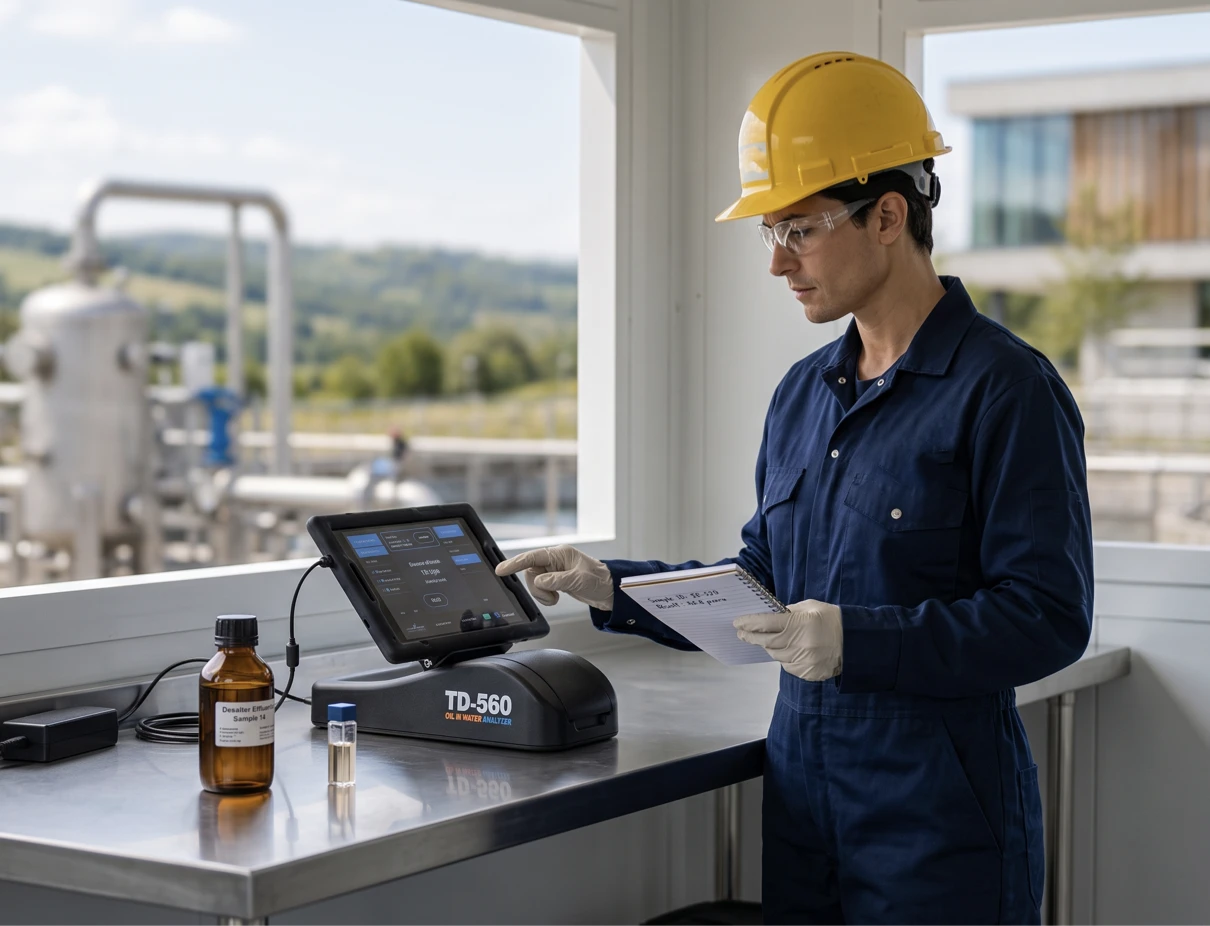
Mixing time, extraction ratio, settling time, sample volume and measurement timing should be consistent. Oil can separate or adhere to surfaces, so a procedure that changes between operators can cause variability even when the analyser is stable. See the oil-in-water sampling guide.
When should an analyser be recalibrated?
- When the target oil or product changes.
- After a failed verification check.
- After significant maintenance or optical cleaning.
- When the water matrix or preparation method changes materially.
- At the interval required by the site quality system.
Build an application-specific calibration plan
Ask PMA to review your calibration requirement. Include the target oil, desired units, expected range, sample preparation and any laboratory method used for comparison.